What is the Lovable AI app builder?
Lovable is a chat tool that turns a written request into a working web app, database and hosting included. You type "a quote calculator for my sales team with a login", and it builds the screens and the data behind them.
According to Lovable's own FAQ, new apps created since 13 May 2026 run on TanStack Start and older ones on React with Vite. Data sits in a PostgreSQL database, either in Lovable Cloud or in your own Supabase project. Publishing to a lovable.app address is free on every plan. A custom domain needs a paid plan.
The same FAQ says Lovable "does not generate React Native projects". What you get is a web app. It works in a phone browser. A native app for the App Store is outside what Lovable makes.
What can a small business build with Lovable?
Lovable is strongest at small web apps with a login and a database behind them. For a business of 5 to 50 people that usually means internal tools the team opens every day.
- A quote calculator that reads your price list and applies the discount tier.
- A client portal where customers see the status of their order or project.
- An onboarding checklist that replaces the spreadsheet nobody updates.
- A landing page for a new offer, wired to a form.
These are the same internal tools a vibe code VA builds in Lovable, Bolt or Replit. One limit matters for existing software. Lovable's FAQ says Git sync creates a new repository and "you cannot connect an existing one". So Lovable suits new tools better than changes to an app your developers already maintain.
How much does Lovable cost?
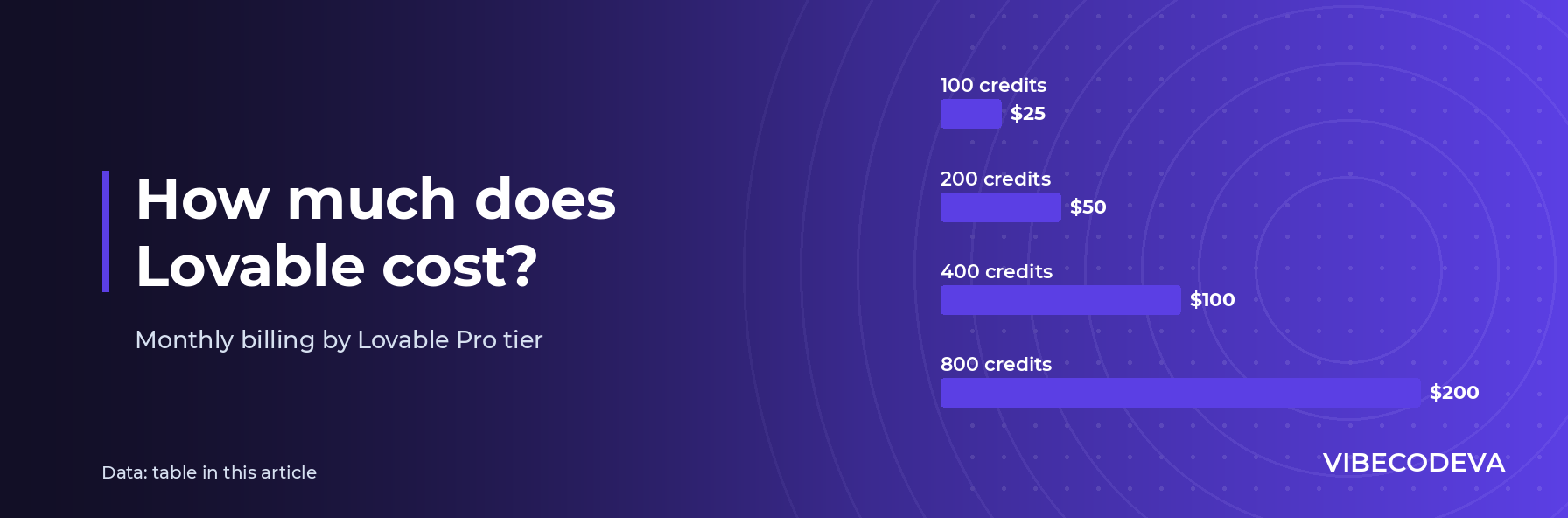
Lovable Pro starts at $25 a month for 100 credits, according to Lovable's plans page. You pick a credit tier, and the price scales with it. Annual billing gives two months free.
| Lovable Pro tier | Monthly billing | Annual billing, per month |
|---|---|---|
| 100 credits | $25 | $21 |
| 200 credits | $50 | $42 |
| 400 credits | $100 | $84 |
| 800 credits | $200 | $167 |
The tiers keep going up to 10,000 credits for $2,250 a month. Business costs about double the Pro price for the same credits ($50 a month for 100) and adds single sign-on, role-based access and a data processing agreement. Enterprise is priced by Lovable's sales team.
The free plan gives 5 credits a day, up to 30 a month. Pro and Business also get 5 daily credits on top of the monthly ones. Every plan, the free one included, allows unlimited workspace members, private projects and Git sync. Code editing, code download and custom domains start at Pro.
How many credits does a Lovable request use?
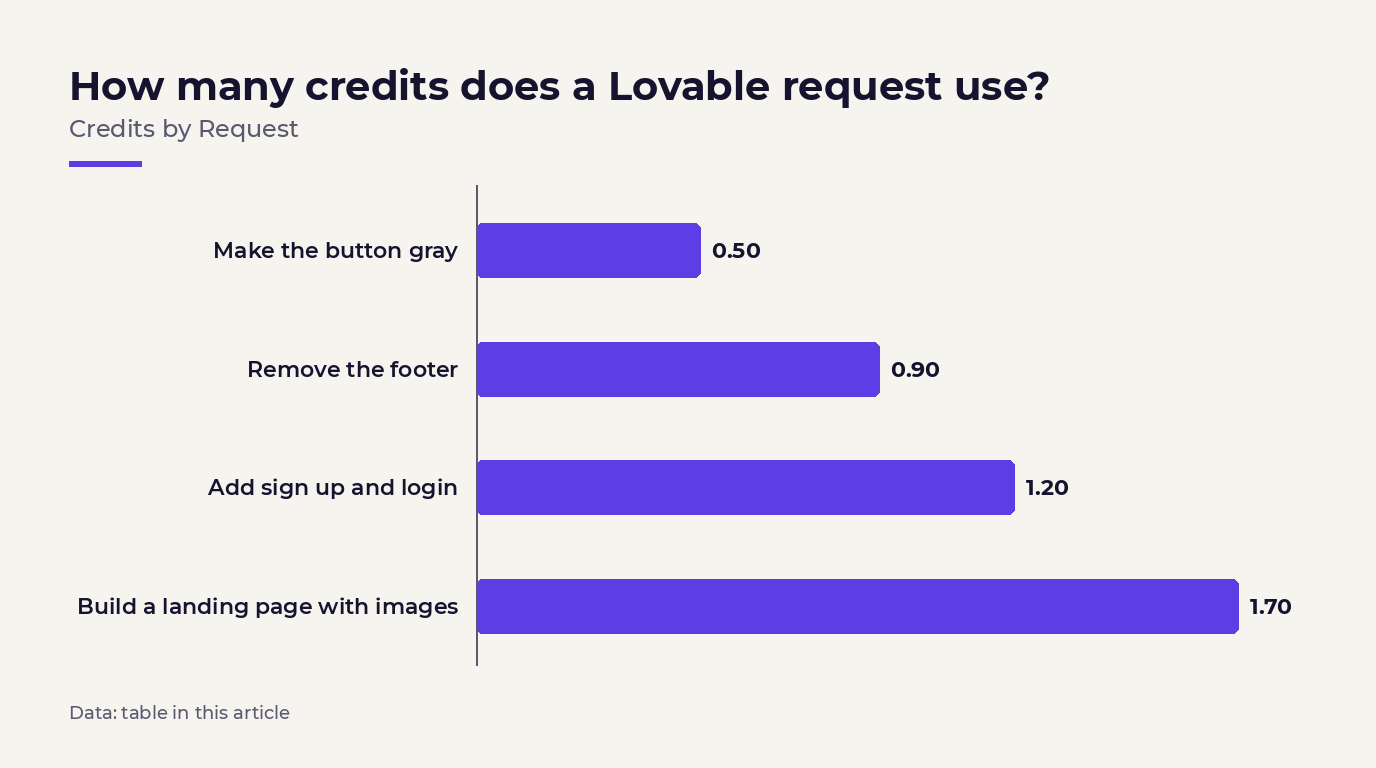
A Lovable request costs between half a credit and about two credits, depending on how much work it is. Lovable's pricing page lists these examples for Default mode.
| Request | Credits |
|---|---|
| Make the button gray | 0.50 |
| Remove the footer | 0.90 |
| Add sign up and login | 1.20 |
| Build a landing page with images | 1.70 |
Plan mode, where Lovable thinks through a change before building it, costs 1 credit per message. The FAQ adds 10 free "Try to fix" attempts, each one available again 24 hours after use.
Here is what that means in practice. On the $25 tier, 100 credits cover about 83 requests the size of "add sign up and login". Monthly credits expire two months after they are issued, and daily credits do not roll over. A builder who works on Lovable every day will move up a tier or two quickly, so budget for the $50 or $100 tier from the start.
What does Lovable leave to you?
Lovable writes the code. A person still decides what gets built and tests it before the team relies on it.
ToolJet's comparison of AI app builders tells buyers to "check generated access rules and operating costs" before they rely on an app, and warns that a security scan does not replace those tests. It also advises keeping the cost of building and editing apart from hosting, backend and AI usage once the app runs. A login that lets one client see another client's orders is exactly the kind of mistake nobody catches without testing.
Then there is the work around the app. The quote calculator needs your current price list. The portal needs data from your CRM. When HubSpot changes a field in month three, someone has to notice the broken sync and fix it. That is where most of the hours go.
Who should run Lovable in your business?
Whoever runs Lovable needs hours every week and a clear list of what to build. For most owners that rules out doing it themselves.
| You, after hours | A one-off freelancer | A full-time vibe code VA | |
|---|---|---|---|
| Time it takes from you | Evenings and weekends | A brief per project | A list you add to on Monday |
| When something breaks later | You fix it | A new invoice | Part of their job |
| Builds beyond Lovable | Whatever you learn | The scoped project | Zapier, Make, n8n, Airtable, pages |
| Whose Lovable account | Yours | Often theirs | Yours |
VibeCodeVA places one full-time builder from Latin America or the Philippines for $1,500 a month, all in. That covers recruiting, the contract and payroll through Deel, HR and a free replacement in the first two months. The details are on the VibeCodeVA pricing page.
Before you see a profile, every candidate passes a practical build test: a small automation and a one-page tool from a written brief. You get 3 tested profiles within 72 hours, and most roles are filled in 2 to 3 weeks. The builder works in your own Lovable account, you pay the seat, and you own everything they build. With Lovable Pro at 200 credits, the total comes to $1,550 a month for one person building full time. The steps from brief to first build are on how hiring a builder works.
Is Lovable worth it for a small business?
Lovable is worth it when you have a steady list of small tools to build and someone with the hours to run it. At $25 to $100 a month, the subscription is the cheap part of the setup.
It is a poor fit for production software with thousands of users or for security-critical systems. Those need an engineer. Adaptive Teams, the company behind VibeCodeVA, places forward deployed engineers for that heavier work from $4,000 a month.
Start with one tool that saves an hour a day, such as the quote calculator or the lead form that lands in your CRM. If that gets used, the next five ideas on your list are the case for a full-time builder. Nate Ginsburg and Menno Gottmer, who started Adaptive Teams, have hired remote talent this way since 2018.
Want someone to run Lovable for you? Get 3 tested builder profiles in 72 hours.