A vibe code VA is a full-time remote assistant who builds things with AI tools instead of doing the admin by hand. You describe what you need. They describe it to Claude, ChatGPT, Lovable or Cursor, check what comes back, and connect it to the tools your business already runs on.
The name comes from vibe coding: building software by telling an AI what you want in plain language. A vibe code VA does that as a job, eight hours a day, for one company.
What does a vibe code VA build?
Four kinds of work, all small enough to finish in days:
- Automations. A new lead lands in the CRM with the source filled in and the owner pinged in Slack. Invoices get filed, reports get sent, follow-ups get drafted. Usually in Zapier, Make or n8n.
- Internal tools. A quote calculator, a dashboard, a client portal, a tracker the team opens every day. Built with Lovable, Bolt, Replit, Airtable or Google Apps Script.
- Sites and pages. Landing pages, forms, page updates, a simple site for a side offer.
- AI workflows. A custom GPT or Claude project that drafts proposals from your past ones, or sorts support replies before you read them.
What they do not build: production software for thousands of users, security-critical systems, or anything a senior engineer has to own. For that you need an engineer.
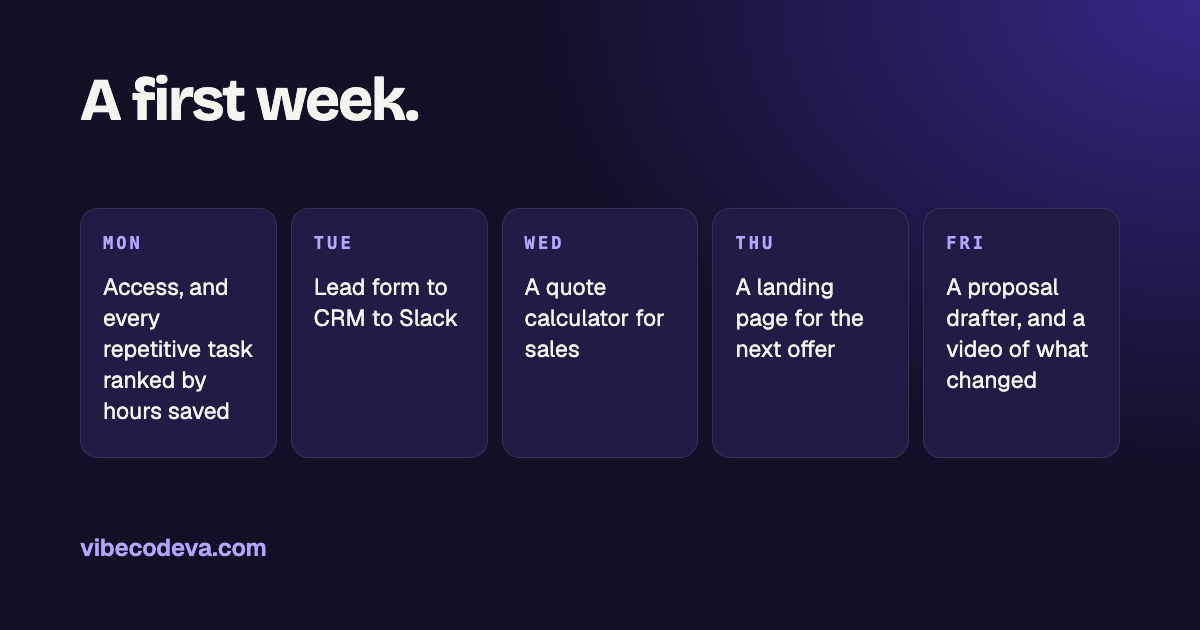
What does a first week look like?
A realistic first week for a business that uses HubSpot, Slack and Google Workspace:
| Day | What gets built |
|---|---|
| Monday | Access, and a list of every repetitive task ranked by hours saved |
| Tuesday | Lead form to CRM to Slack |
| Wednesday | A quote calculator for the sales team |
| Thursday | A landing page for the next offer |
| Friday | A proposal drafter, and a short video of everything that changed |
None of these is a big project. That is the point. One automation that saves an hour a day beats one large app nobody finishes.
How is a vibe code VA different from a normal VA?
A normal virtual assistant does the admin. A vibe code VA builds the things that remove it. Both are organised, reliable and good in English. The difference is what they are hired and tested for: a vibe code VA has to pass a practical build test before a client ever sees their profile.
It is also different from hiring a developer. A developer costs more and usually wants harder problems than a Zap and a landing page. A vibe code VA is the step before that.
What does a vibe code VA cost?
Through VibeCodeVA, one full-time builder costs $1,500 a month, all in. That covers their salary, recruiting, the contract and payroll through Deel, HR and a free replacement in the first two months. You pay for your own tool subscriptions.
For comparison, public 2026 price guides put freelance vibe coding work at $50 to $150 an hour, and a build from an automation or AI agency at $5,000 or more per project.
| Freelancer | Automation agency | Full-time vibe code VA | |
|---|---|---|---|
| Cost | $50 to $150 an hour | $5,000+ per build | $1,500 a month |
| Works on | One scoped project | One scoped project | Your whole list |
| When something breaks in month three | New invoice | New invoice | Part of their job |
Where do vibe code VAs come from?
Ours come from Latin America (Colombia, Argentina, Brazil) and the Philippines. Latin America overlaps US working hours. In the Philippines, working US hours on a night shift is normal.
How do you hire one?
- Write the brief. Your tools, your time zone and the first five things on your list.
- Test for building, not for talking about it. Give candidates a small automation and a one-page tool to build from a written brief, and score every candidate on the same rubric.
- Interview the ones who pass. Ask them to walk you through what they built and what they would change.
- Give them their own logins. Never share yours. Work happens in accounts in your name, so you own everything and can remove access the day they leave.
- Start with the list. Hand it over on day one and let them rank it by hours saved.
That is the process VibeCodeVA runs for you: you send the brief, and 3 tested profiles arrive within 72 hours. Most roles are filled in 2 to 3 weeks.
Is a vibe code VA right for your business?
It fits if you have a list of things you would build "if someone had the time", you already pay for tools like a CRM, Slack and an AI subscription, and the builds are small and frequent. It does not fit if you need one large, complex product. Then hire an engineer or an agency for that project.